
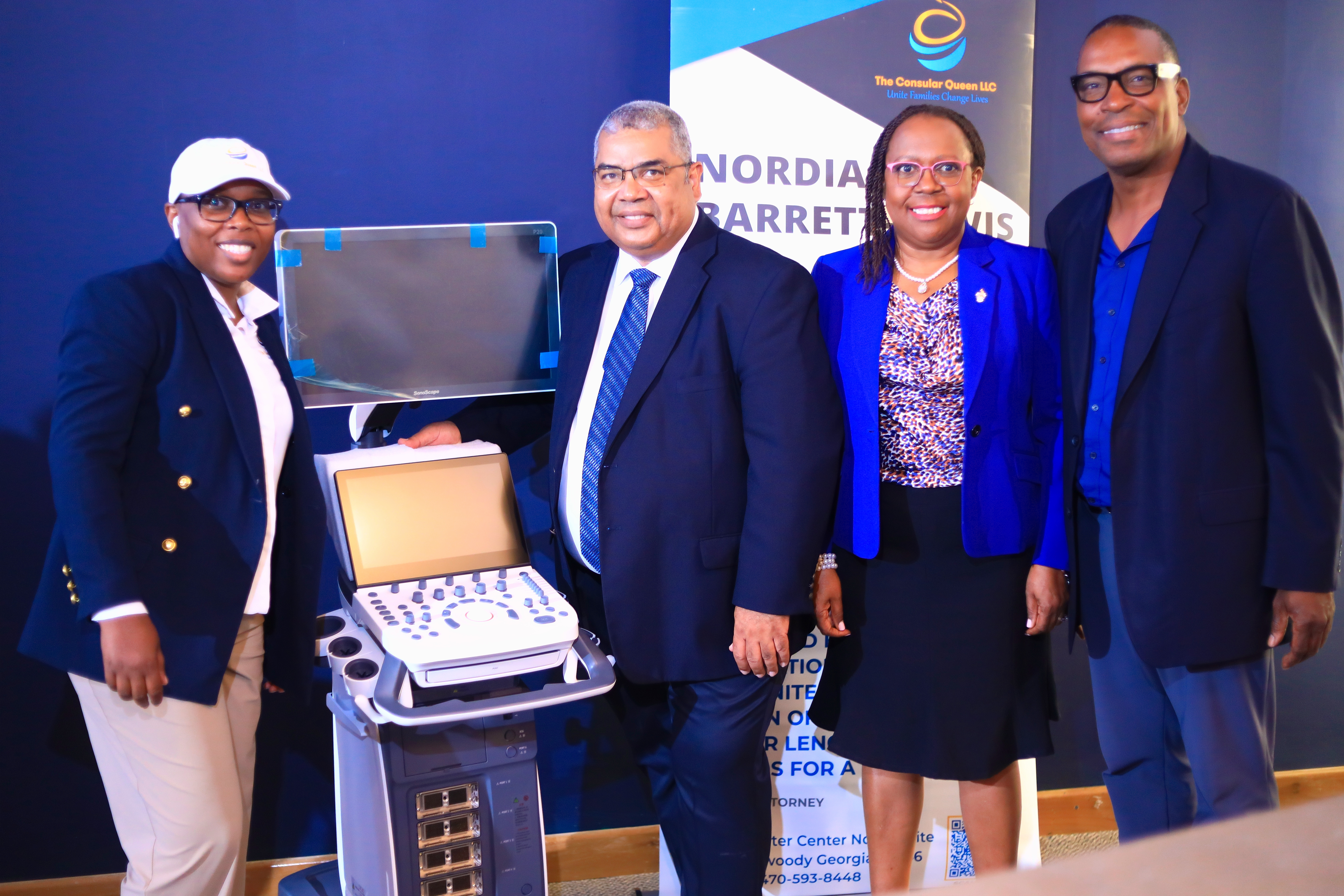
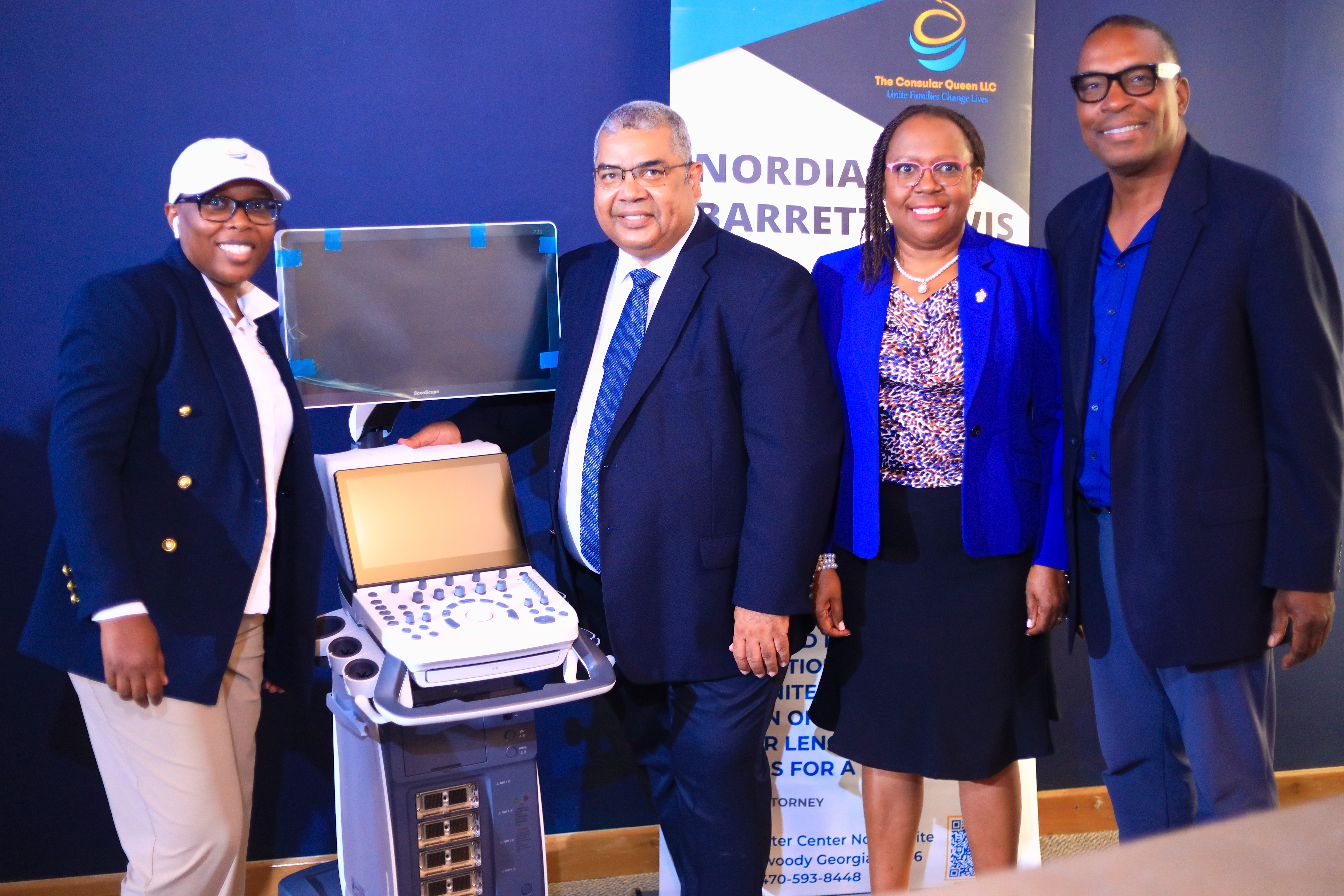
Nordia Barrett-Lewis, Dr. John Harriott, Professor Aldrie Henry-Lee, Pro Vice-Chancellor of The University of the West Indies (UWI), and Dr. Carl Bruce pose alongside an ultrasound machine donated to the Hugh Wynter Institute for Reproductive Healthcare and Endoscopic Surgery (HWI-RHES) at UWI, Mona, during a donor appreciation ceremony.
After undergoing several surgeries for reproductive health challenges, Jamaican immigration consultant and philanthropist Nordia Barrett-Lewis has given back to the institution that helped improve her quality of life, donating a high-definition ultrasound machine valued at more than US$18,000 to the Hugh Wynter Institute for Reproductive Healthcare and Endoscopic Surgery (HWI-RHES) at The University of the West Indies (UWI), Mona.
The donation, which was formally recognised during a Donor Appreciation and Dedication Ceremony on Thursday, October 29, 2026, is expected to strengthen the diagnosis and treatment of women's reproductive health conditions while improving postgraduate training for doctors specialising in obstetrics and gynaecology.
For Barrett-Lewis, founder and chief executive officer of Barrett Immigration, the decision to give back was personal. Having undergone several procedures, including her most recent surgery at the institute in February 2026, she said the care she received had made a significant difference in her life.
"I have had several surgeries, not all of them done here, but the last portion has been done here and it has given me a better quality of life," she said.
Although she now resides overseas, Barrett-Lewis continues to return to Jamaica for medical care. Following her surgery, she approached her doctor to find out how she could support the institute. After consultations with the medical team, an ultrasound machine was identified as a priority.
"My hope is that women that are going through the process of whether having children or simply having reproductive issues may be able to get the quality care that they want," she explained, adding that access to modern medical equipment is just as important as having qualified healthcare professionals.
The donation is another example of Barrett-Lewis's commitment to giving back to Jamaica. Earlier this year, she also supported students at The UWI through a scholarship donation.
Director of the Hugh Wynter Institute, Dr John Harriott, welcomed the contribution, noting that it would strengthen the institution's ability to provide specialised reproductive healthcare while addressing an important gap in medical training.
"We're very grateful for this donation of an ultrasound. It's a high-definition ultrasound. It's part of our mission to use technologies to continue to advance women's health care," Dr Harriott said.
He explained that doctors pursuing postgraduate training in obstetrics and gynaecology currently have limited exposure to gynaecological ultrasound, an area he has been working to incorporate into the training curriculum.
"In particular, this ultrasound is going to serve purposes for training residents in obstetrics and gynaecology in the field of gynaecological ultrasounds. It's an area that is deficient in the programme right now, and this will serve as a template for introduction of that in the curriculum," he said.
The institute is also planning a workshop with international experts in March 2027 to further strengthen training in this area. Beyond its educational value, the machine will support early diagnosis, emergency assessments and ultrasound-guided surgical procedures, improving the care available to women with reproductive health complications.
Dr Harriott also used the occasion to highlight the range of services offered by the institute, which he described as one of Jamaica's best-kept secrets. These include fertility care, contraception and advanced minimally invasive surgery, particularly for women suffering from conditions such as endometriosis.
"A lot of women in Jamaica suffer from chronic pelvic pain, secondary to endometriosis, which is quite debilitating," he said, noting that the institute has helped improve the lives of several patients, including Barrett-Lewis.
Dr Carl Bruce, Senior Director of Clinical Services at the University Hospital of the West Indies (UHWI), said the donation would have far-reaching benefits for patient care, medical education and research, not only in Jamaica but across the Caribbean.
"First, in the area of patient care, our women's health divisions will be able to use this technology to diagnose with precision and accuracy. But importantly, we're able to train another generation of doctors who can use these technologies for their patients, and it's training not only for the doctors in Jamaica but across the region," he said.
Dr Bruce added that access to advanced medical technology also supports research into health conditions affecting women in Jamaica and the wider Caribbean, helping medical professionals better understand and respond to patients' needs.
He also pointed to the importance of improving access to fertility services against the background of Jamaica's declining fertility rate, noting that having children is not always straightforward for women experiencing reproductive health challenges.
"Some people may say it's so simple to have a baby, but for some women, it's a real challenge. And technologies such as these assist our doctors in diagnosing and in treating those women who may have difficulty having a baby or fertility problems," he said.
Acknowledging concerns about the cost of fertility treatment, Dr Bruce said the university has been working to make services more accessible, with investments in technology and training expected to help reduce costs over time. He noted that donations such as this also benefit patients attending UHWI's obstetrics and gynaecology services.
"We want to raise public awareness on fertility management, and we want to say to our women across the country, we are here to help, and we are here to ensure that we bring the technologies to our country so that you do not have to travel to get these treatments," he said.
For Barrett-Lewis, the donation is an opportunity to help other women receive the same quality of care that made a difference in her own life. Her contribution also highlights the important role that former patients and private donors can play in helping healthcare institutions improve services, strengthen medical training and expand access to specialised treatment.